Prestressed concrete has transformed modern construction by allowing engineers to design longer spans, thinner sections, and more durable structures than conventional reinforced concrete ever could. At the heart of this technology lie two distinct construction methods: pretensioning and post-tensioning. While both techniques rely on the same core principle — introducing compressive stress into concrete before it is subjected to service loads — they differ significantly in process, equipment, application, and cost.
Understanding the difference between pretensioning and post-tensioning is essential for engineers, contractors, and project managers who need to select the right method for a given structure. Choosing incorrectly can lead to unnecessary costs, construction delays, or performance issues down the line. This guide compares pretensioning vs post-tensioning in detail, explains when each method should be used, and looks at how materials like PC strand and PC wire play a role in each system.
Pretensioning vs Post-tensioning at a Glance
- Pretensioning is ideal for factory-produced precast elements such as beams, sleepers, and hollow-core slabs.
- Post-tensioning is preferred for large, cast-in-place structures such as bridges, high-rises, and parking garages.
- Pretensioning transfers the prestressing force through a bond between the steel and the surrounding concrete.
- Post-tensioning transfers the prestressing force through mechanical anchorages at the ends of the member.
- Both methods improve structural performance, but each is suited to different project types, spans, and budgets.
The sections below break this down further, starting with the fundamentals of prestressing itself.
What Is Prestressing?
Prestressing is a construction technique in which internal stresses are deliberately introduced into a concrete member before it carries any external load. The purpose is simple: concrete is strong in compression but weak in tension, and it tends to crack under tensile stress. By pre-compressing the concrete using high-strength steel tendons, engineers counteract the tensile forces that will develop once the structure is in service.
This is achieved by stretching (tensioning) steel tendons — typically PC strand, PC wire, or prestressing bars — and anchoring them so that the tension in the steel is transferred into compression in the concrete. The result is a structural member that can resist much greater loads, span longer distances, and develop fewer cracks over its service life. This is the foundation for comparing pretensioning and post-tensioning, since both methods apply this same principle in different ways.
Common prestressing materials include:
- PC Strand — a group of steel wires twisted together, offering high tensile strength and commonly used in both pretensioning and post-tensioning systems.
- PC Wire — single high-strength steel wire, used in specific pretensioned applications.
- Prestressing Bars — solid, high-strength steel bars used less frequently than PC strand, typically in specialized applications such as rock and soil anchoring, heavy bridge construction, nuclear containment structures, and temporary stressing systems where high force is needed with fewer individual tendons.
The two primary methods used to apply this compressive force are pretensioning and post-tensioning, and the distinction between them comes down to when the tendons are tensioned relative to the concrete pour.
What Is Pretensioning?
Definition
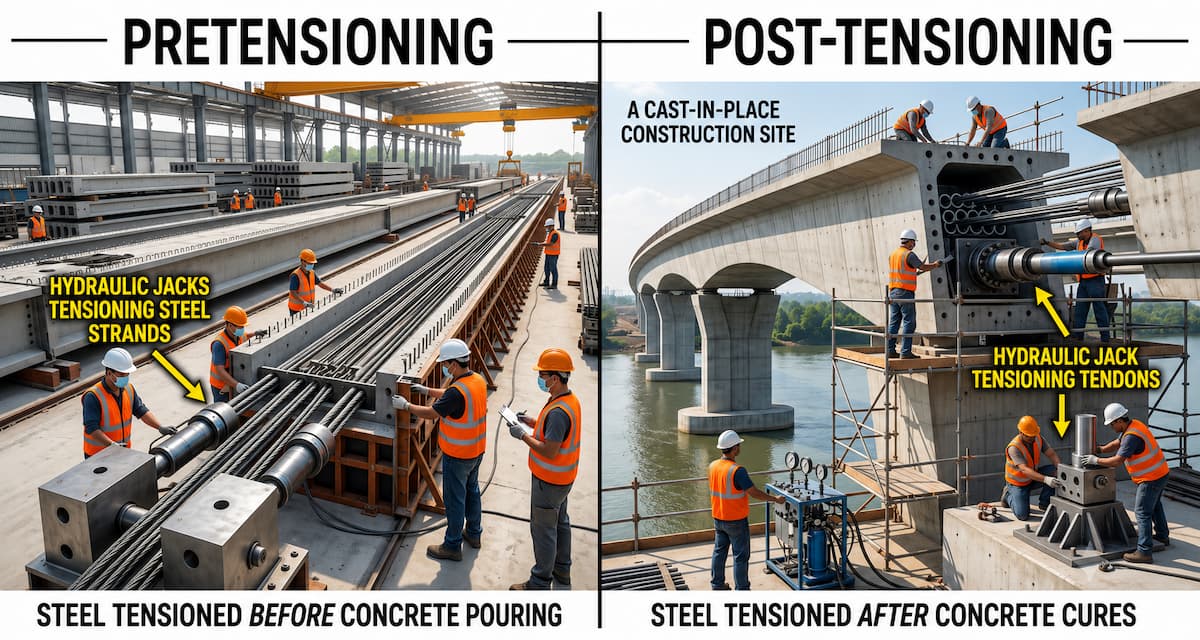
Pretensioning is a method of prestressing concrete in which the steel tendons are tensioned before the concrete is poured. Once the concrete hardens and gains sufficient strength, the tendons are released, and the prestressing force is transferred to the concrete through bond action along the length of the tendon.

How Pretensioning Works
Pretensioning follows a well-defined sequence, typically carried out in a controlled factory or precast yard setting:
- Stretch steel tendons — PC strand or PC wire is tensioned between fixed anchorages on a casting bed using hydraulic jacks.
- Pour concrete — Concrete is cast around the tensioned tendons within molds or formwork.
- Concrete cures — The concrete is allowed to gain adequate compressive strength, often accelerated using steam curing.
- Release tendons — Once the required strength is reached, the tendons are cut or released from the anchorages.
- Prestress transferred through bond — As the tendons attempt to return to their original length, the bond between the steel and surrounding concrete transfers the compressive force into the member.
Equipment Used
- Long-line casting beds
- Hydraulic jacks for tensioning
- Fixed end anchorages
- PC Strand
- PC Wire
Advantages of Pretensioning
- Excellent quality control — produced under factory-controlled conditions
- Factory production — allows repetitive, standardized manufacturing
- High durability — consistent curing and material quality
- Uniform quality — reduced variability compared to site-cast members
- Faster mass production — ideal for producing large quantities of similar elements
Limitations of Pretensioning
- Transportation limitations — precast members must be transported from the factory to the site, limiting size and weight
- Requires casting beds — needs dedicated, fixed infrastructure
- Less flexible for large structures — not practical for very long spans or complex geometries that cannot be precast and transported
Common Applications
- Railway sleepers
- Utility poles
- Bridge girders
- Precast beams
- Hollow core slabs
What Is Post-tensioning?
Definition
Post-tensioning is a method of prestressing concrete in which the steel tendons are tensioned after the concrete has been poured and has gained sufficient strength. Tendons are placed inside ducts embedded in the concrete, then stressed and anchored at the ends of the member once the concrete has cured.

How Post-tensioning Works
- Install ducts — Hollow ducts (metal or plastic) are positioned within the formwork before concrete placement, following the required tendon profile.
- Pour concrete — Concrete is cast around the ducts.
- Concrete gains strength — The structure is allowed to cure and reach the necessary strength before stressing begins.
- Thread or install tendons — The sequence here depends on the system. For bonded systems, PC strand is typically threaded through the ducts after the concrete has reached the required strength. For unbonded systems, the grease-coated, PE-sheathed tendons are usually installed before the concrete is poured.
- Stress tendons — Hydraulic jacks apply tension to the tendons from one or both ends.
- Anchor tendons — Once the desired stress is achieved, the tendons are locked in place using wedges and anchorage devices.
- Grouting (bonded systems only) — Cementitious grout is injected into the ducts to bond the tendon to the surrounding concrete and provide corrosion protection. Unbonded systems skip this step, since the grease and sheath already provide corrosion protection and allow the tendon to move freely.
Equipment Used
- Hydraulic jacks
- Anchorage assemblies
- Wedges
- Ducts
- PC Strand
Advantages of Post-tensioning
- Longer spans — well suited for large, open structural spans
- Thinner slabs — reduces overall structural depth and dead weight
- Reduced cracking — precise control over stress distribution
- Design flexibility — tendons can follow curved profiles to match load demands
- Lower material usage — optimized structural sections reduce concrete and steel consumption
Limitations of Post-tensioning
- More complex installation — requires precise duct placement and tendon profiling
- Skilled labor required — stressing and anchoring operations demand trained crews
- Higher equipment cost — specialized jacks, anchorages, and grouting equipment add expense
Common Applications
- Bridges
- Parking garages
- High-rise buildings
- Commercial buildings
- Water tanks
- Stadiums
Difference Between Pretensioning and Post-tensioning
Here’s a quick comparison of pretensioning and post-tensioning:
| Factor | Pretensioning | Post-tensioning |
| Timing of Tensioning | Tendons stressed before concrete is poured | Tendons stressed after concrete hardens |
| Construction Process | Factory-based, standardized | Often site-based, more variable |
| Bond Mechanism | Bond transfer between steel and concrete | Bonded (grouted) or unbonded (greased) systems |
| Tendon Type | PC Strand, PC Wire | Primarily PC Strand |
| Casting Location | Precast yard or factory | Typically cast-in-place on site |
| Equipment | Casting beds, hydraulic jacks | Hydraulic jacks, anchorages, ducts |
| Transportation | Members transported from factory to site | No transportation needed; cast in final position |
| Flexibility | Limited to standard, transportable shapes | High flexibility for complex geometries and spans |
| Cost | Lower for repetitive standard units | Higher due to labor and equipment, but efficient for large projects |
| Maintenance | Generally low | Slightly higher, especially for unbonded systems |
| Typical Structures | Beams, slabs, poles, sleepers | Bridges, slabs, high-rises, tanks |
| Quality Control | Very high (factory-controlled) | Dependent on site supervision |
| Construction Speed | Fast for mass production | Slower due to on-site stressing operations |
| Span Capability | Moderate spans | Long spans |
| Durability | High, consistent curing conditions | High, with proper grouting and corrosion protection |
Pretensioning vs Post-tensioning: Which One Is Better?
There is no universal answer to whether pretensioning or post-tensioning is “better” — the right choice depends on several project-specific factors:
- Project size — Small to medium precast elements favor pretensioning; large-scale structures favor post-tensioning.
- Budget — Pretensioning is often more economical for standardized, mass-produced units, while post-tensioning may offer better long-term value for complex structures.
- Construction method — Precast-heavy projects lean toward pretensioning; cast-in-place projects lean toward post-tensioning.
- Factory vs site production — If a factory is nearby and transportation is feasible, pretensioning offers efficiency. If site conditions demand in-place casting, post-tensioning is preferred.
- Span requirements — Post-tensioning is generally better suited for longer spans and heavier loads.
- Transportation — Large or heavy pretensioned members can be difficult and costly to transport; post-tensioning avoids this issue entirely.
- Structural performance — Both methods deliver excellent performance when properly designed and executed; the decision often comes down to logistics and structural geometry rather than performance alone.

Is Pretensioning Better Than Post-tensioning?
Not necessarily — it depends on the application. Pretensioning is generally the better choice for standardized, factory-produced elements where consistency and speed matter most. Post-tensioning is generally the better choice for large, site-specific structures that need long spans or custom geometries. Neither method is universally superior; each is simply optimized for different project conditions.
Which Is More Expensive?
Pretensioning is usually more cost-effective for mass-produced, standardized units, since factory production reduces labor and material waste. Post-tensioning tends to involve higher upfront costs due to specialized equipment, skilled labor, and on-site stressing operations — but it can be more economical overall for large structures where transporting precast elements would be impractical or costly.
Which Lasts Longer?
Both methods can achieve long-term durability when properly designed, executed, and protected against corrosion. Pretensioned elements benefit from consistent factory curing conditions, while post-tensioned structures rely on proper grouting (for bonded systems) or intact grease and sheathing (for unbonded systems) to protect tendons from corrosion over time. Long-term performance depends more on quality control and detailing than on the method itself.
Which Requires Less Maintenance?
Pretensioned elements generally require less maintenance, since the prestressing steel is fully embedded and bonded within the concrete at the time of manufacture. Post-tensioned structures, particularly those using unbonded tendons, may require periodic inspection of anchorages and, in some cases, tendon replacement — though this is also an advantage, since unbonded tendons can be de-stressed and replaced if needed.
Can Pretensioning and Post-tensioning Be Used Together?
Yes. In many large infrastructure projects, both methods are used together — pretensioned precast elements (such as girders or deck panels) are combined with post-tensioned connections or continuity tendons on site. This hybrid approach takes advantage of the factory quality control offered by pretensioning and the design flexibility offered by post-tensioning, and it’s common in segmental bridge construction and long-span precast structures.
PC Strand vs PC Wire in Prestressing
Both PC strand and PC wire are essential materials in prestressed concrete, but they serve different roles depending on the application.
PC Strand
- Offers higher tensile strength compared to single wires
- Used in most post-tensioning systems due to its strength and flexibility
- Widely applied in bridges, buildings, and heavy infrastructure projects
- Available in various configurations, including 7-wire strand for high-load applications
PC Wire
- Used in specific pretensioned applications such as railway sleepers, concrete poles, and certain precast products
- Offers a cost-effective solution for applications with lower tensioning force requirements
- Note that most modern pretensioning systems also use 7-wire PC strand, so the choice between PC wire and PC strand depends on the specific product and load requirements rather than the method alone

Why Low-Relaxation PC Strand Matters
Modern post-tensioning systems typically specify a low-relaxation (LR) 7-wire PC strand, manufactured in accordance with ASTM A416 Grade 270 or equivalent international standards. Low-relaxation strand loses tension more slowly over time compared to standard-relaxation strand, which helps minimize long-term prestress losses and maintain structural performance throughout the service life of the structure. This is one reason why strand quality and certification matter as much as the choice between pretensioning and post-tensioning itself.
The choice between PC strand and PC wire ultimately depends on the structural requirements of the project, including load demands, span length, and the specific prestressing method being used. Sourcing high-quality, certified products is critical, since the performance and safety of the entire structure depend on the reliability of these materials.
Why Manufacturers Prefer Pretensioning for Mass Production
Factory-based pretensioning is the standard choice for manufacturers producing large volumes of standardized precast elements. At Wasungen, most customers producing railway sleepers, spun piles, and hollow-core slabs choose pretensioning because factory production delivers higher consistency, lower labor costs, and faster production cycles compared to site-based methods. This is a key reason pretensioning remains dominant in precast manufacturing, even as post-tensioning continues to grow in cast-in-place and large-span applications.
Quality Control of Prestressing Steel
Regardless of whether prestressing steel is used in pretensioning or post-tensioning, consistent quality control is essential to structural safety. Reputable manufacturers subject every coil of PC strand and PC wire to rigorous inspection before shipment, including:
- Tensile strength testing
- Yield strength testing
- Elongation testing
- Relaxation testing
- Diameter tolerance inspection
- Surface condition inspection
These checks ensure that the prestressing steel performs as expected under sustained load, regardless of which prestressing method — pretensioning or post-tensioning — it’s used in.
Advantages of Prestressed Concrete
Regardless of whether pretensioning or post-tensioning is used, prestressed concrete offers significant benefits over conventional reinforced concrete:
- Longer spans — enables construction of larger, column-free spaces
- Reduced cracking — improves durability and reduces maintenance needs
- Higher load capacity — supports heavier loads with less material
- Improved durability — better resistance to environmental and structural stresses
- Less maintenance — fewer cracks mean less water infiltration and corrosion risk
- Material savings — smaller cross-sections reduce concrete and steel usage
- Faster construction — particularly with pretensioned precast elements
Common Applications of Prestressed Concrete
Prestressed concrete, using either pretensioning or post-tensioning, is used extensively across industries:
- Bridges
- Highways
- Buildings
- Parking structures
- Marine structures
- Railway sleepers
- Water tanks
- Industrial plants
- Wind turbine foundations
Choosing the Right Prestressing Steel Supplier
Whichever method you choose — pretensioning or post-tensioning — the long-term performance of the structure depends heavily on the quality of the prestressing steel itself. When selecting a PC strand or PC wire supplier, buyers should consider:
- Manufacturing capability — consistent production capacity and process control
- Compliance with international standards — such as ASTM A416, BS 5896, or equivalent
- Third-party testing — independent verification of mechanical properties
- Export experience — familiarity with international shipping, documentation, and certification requirements
- Technical support — guidance on selecting the right product for a given prestressing method and application
TJ Wasungen manufactures PC strand and PC wire for both pretensioning and post-tensioning applications, with products used in railway, bridge, and building projects worldwide. For buyers comparing pretensioning and post-tensioning suppliers, verifying certification and testing records is one of the most important steps before placing an order.
Frequently Asked Questions
What is the main difference between pretensioning and post-tensioning? Pretensioning stresses tendons before pouring concrete, and the force transfers through bond after curing. Post-tensioning stresses tendons after the concrete hardens, using mechanical anchors.
Which is stronger, pretensioning or post-tensioning? Neither is inherently stronger. Post-tensioning suits longer spans and heavier loads, while pretensioning offers better quality control for standard precast units.
Where is pretensioning commonly used? In railway sleepers, utility poles, bridge girders, precast beams, and hollow core slabs — mostly factory-produced.
Where is post-tensioning commonly used? In bridges, parking garages, high-rise buildings, commercial buildings, water tanks, and stadiums needing long spans or thin slabs.
Why is PC strand preferred in post-tensioning? It offers high tensile strength, flexibility for curved duct profiles, and reliable long-term performance under load.
Can PC wire be used in post-tensioning? Occasionally, but PC strand is preferred for its higher strength and easier handling in ducts.
Is pretensioning more economical? Often yes, for standardized precast units, due to factory efficiency. But transportation costs can make post-tensioning more economical for large, site-specific structures.
What are bonded and unbonded post-tensioning systems? Bonded systems grout the tendons after stressing for permanent bonding and corrosion protection. Unbonded systems use greased, sheathed tendons that stay free-moving, easing future maintenance.
Why is grout used in bonded post-tensioning? Grout bonds the tendon permanently to the surrounding concrete and seals the duct, protecting the steel from moisture and corrosion.
Why is Low-Relaxation PC Strand important? It loses tension more slowly over time than standard strand, reducing long-term prestress losses and helping maintain structural performance.
Which method requires less maintenance? Pretensioned elements generally need less maintenance, since tendons are bonded within the concrete at the time of manufacture.
Can pretensioning be repaired? Repair is more difficult than in post-tensioning, since tendons are bonded and embedded; damage typically requires structural assessment and, in some cases, member replacement.
Is post-tensioning safe? Yes, when designed, installed, and inspected according to applicable standards. Anchorages and grouting are engineered to safely maintain tension over the structure’s service life.
What standards apply to PC Strand? Common standards include ASTM A416 (for low-relaxation 7-wire strand) and BS 5896, along with equivalent national and international specifications.
Conclusion
Both pretensioning and post-tensioning achieve the same fundamental goal — introducing compressive stress into concrete to improve its structural performance — but they do so through very different processes. Pretensioning offers superior quality control and efficiency for factory-produced, standardized elements, while post-tensioning provides the flexibility and span capability needed for large, complex, site-cast structures.
Selecting the right prestressing method depends on project size, budget, span requirements, and site conditions. In both cases, the performance and longevity of the final structure depend heavily on the quality of the prestressing materials used. Sourcing high-quality PC strand and PC wire from a reliable supplier is essential for ensuring long-lasting, safe, and durable prestressed concrete structures.